Shakespeare: The World as Stage by Bill Bryson
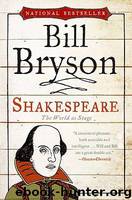
Author:Bill Bryson [Bryson, Bill]
Language: eng
Format: epub, mobi, azw3
Tags: sci_culture
O paradox! black is the badge of hell,
The hue of dungeons and the school of night.
What exactly he meant by “the school of night” is really anyone’s guess. Similarly uncertain is a reference early in The Merchant of Venice to “my wealthy Andrew docked in sand,” which could refer to a ship but possibly to a person. The most ambiguous example of all, however, is surely the line in King Lear that appeared originally (in the Quarto edition of 1608) as “swithald footed thrice the old, a nellthu night more and her nine fold.” Though the sentence has appeared in many versions in the four centuries since, no one has ever got it close to making convincing sense.
“Shakespeare was capable of prolixity, unnecessary obscurity, awkwardness of expression, pedestrian versifying and verbal inelegance,” writes Stanley Wells. “Even in his greatest plays we sometimes sense him struggling with plot at the expense of language, or allowing his pen to run away with him in speeches of greater length than the situation warrants.” Or as Charles Lamb put it much earlier, Shakespeare “runs line into line, embarrasses sentences and metaphors; before one idea has burst its shell, another is hatched out and clamorous for disclosure.”
Shakespeare was celebrated among his contemporaries for the speed with which he wrote and the cleanness of his copy, or so his colleagues John Heminges and Henry Condell would have us believe. “His mind and hand went together,” they wrote in the introduction to the First Folio, “and what he thought he uttered with that easiness that we have scarce received from him a blot in his papers.” To which Ben Jonson famously replied in exasperation: “Would he had blotted a thousand!”
In fact he may have. The one place where we might just see Shakespeare at work is in the manuscript version of a play of the life of Sir Thomas More. The play was much worked on, and is in six hands (one of the authors was Henry Chettle, the man who apologized abjectly to Shakespeare for his part in the publishing of Greene’s Groat’s-Worth). It was never performed. Since its subject was a loyal, passionate Catholic who defied a Tudor monarch, it is perhaps a little surprising that it occurred as a suitable subject to anyone at all.
Some authorities believe that Shakespeare wrote three of the surviving pages. If so, they give an interesting insight, since they employ almost no punctuation and are remarkably-breathtakingly-liberal in their spelling. The word sheriff, as Stanley Wells notes, is spelled five ways in five lines-as shreiff, shreef, shreeve, Shreiue, and Shreue-which must be something of a record even by the relaxed and imaginative standards of Elizabethan orthography. The text also has lines crossed out and interlineations added, showing that Shakespeare did indeed blot-if indeed it was he. The evidence for Shakespeare is based on similarities in the letter a in Shakespeare’s signature and the More manuscript, the high number of y spellings (writing tyger rather than tiger, for instance, a practice
Download
Shakespeare: The World as Stage by Bill Bryson.mobi
Shakespeare: The World as Stage by Bill Bryson.azw3
This site does not store any files on its server. We only index and link to content provided by other sites. Please contact the content providers to delete copyright contents if any and email us, we'll remove relevant links or contents immediately.
Cecilia; Or, Memoirs of an Heiress — Volume 2 by Fanny Burney(31951)
Cecilia; Or, Memoirs of an Heiress — Volume 3 by Fanny Burney(31935)
Fanny Burney by Claire Harman(26598)
We're Going to Need More Wine by Gabrielle Union(19040)
Plagued by Fire by Paul Hendrickson(17409)
All the Missing Girls by Megan Miranda(15981)
Cat's cradle by Kurt Vonnegut(15344)
Bombshells: Glamour Girls of a Lifetime by Sullivan Steve(14063)
For the Love of Europe by Rick Steves(13977)
Leonardo da Vinci by Walter Isaacson(13323)
4 3 2 1: A Novel by Paul Auster(12382)
The remains of the day by Kazuo Ishiguro(8987)
Adultolescence by Gabbie Hanna(8926)
Note to Self by Connor Franta(7667)
Diary of a Player by Brad Paisley(7566)
Giovanni's Room by James Baldwin(7334)
What Does This Button Do? by Bruce Dickinson(6201)
Ego Is the Enemy by Ryan Holiday(5425)
Born a Crime by Trevor Noah(5379)
